安妮日记 *The Diary of a Young Girl*
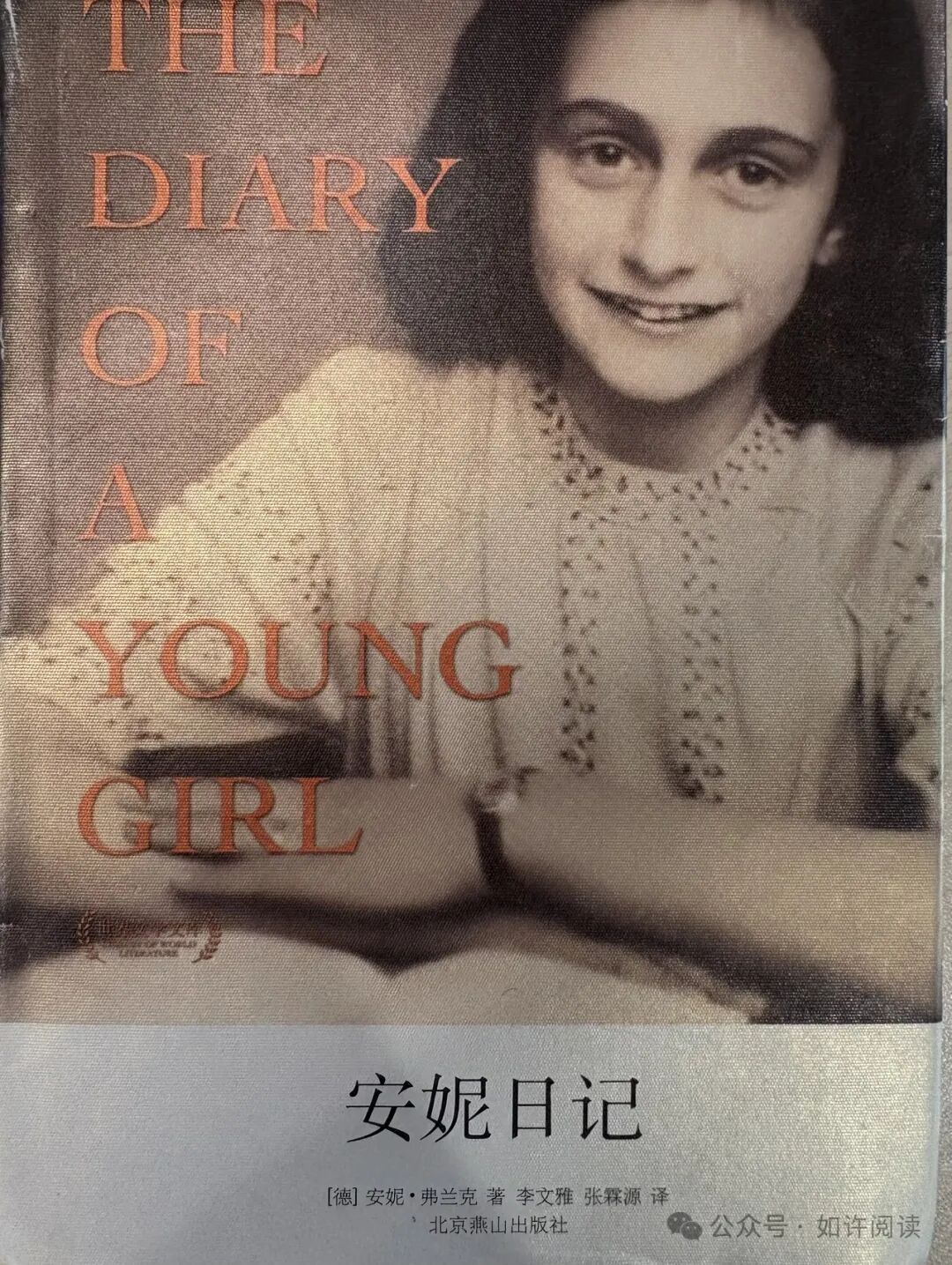
安妮·弗兰克,1929年出生在德国法兰克福的一个犹太富商家庭里,在家人的呵护下度过了幸福的童年。1934年,弗兰克一家移居到荷兰的阿姆斯特丹。
1940年,德国入侵荷兰,随后在荷兰实行严酷的反犹政策。1942年7月5日,德国当局传唤安妮的姐姐。第二天,弗兰克一家仓皇出逃,躲进“秘密小屋”。同其他四名避难的犹太人一起在“秘密小屋”里躲藏了两年。
在日记里,少女安妮用真诚的笔触记录了两年多的避难生活:暗无天日的躲藏,常伴身边的恐惧,极端匮乏的物资,扭曲的人际关系,青春期的叛逆,对异性的好奇。还有她的渴望、梦想,以及对战争的反思。她渴望自由,渴望大自然,渴望爱,不甘于庸庸碌碌过一生,梦想着有为之献身的事业,成为一名记者,写出伟大的作品,“永远活在人们心中”。
阅读是一件非常私人的事情,每个人因为生活阅历的不同,所处的环境和人生阶段的不同,对所读作品的感受也不尽相同。
读《安妮日记》,身体里的两个“我”常受触动:一个是少女时代的自己,很羡慕安妮,羡慕她遇到很好的老师、有一位理解她懂她的爸爸,还有那么多的异性追求者;另一个是作为一名妈妈,每每读到叛逆少女对妈妈的吐槽,我都不禁端正坐姿,以之为鉴,自己可千万不要成为这样的妈妈!
很不幸,安妮没有等来战后重获自由的那一天。1944年8月4日,“秘密小屋”被告发,盖世太保闯进安妮的藏身之地,把八名藏匿者逮捕,并转送至集中营。1945年春天,安妮在贝尔根·贝尔森集中营去世,当时她未满十六岁。
然而,她的文字承载着她的思想,在八十年后的今天,依然鼓舞着我,记录当下。
我常常会因为自己文笔不好,见解不深刻,而犹豫要不要写东西。《安妮日记》让我更加坚信我们每一个人都是特定的时代洪流中的独特的一分子。个体的声音是珍贵的。我们要做的就是把自己真实的所想所感记录下来。就像安妮说的“就算没那个出书或写稿的能耐,我还可以为自己写点什么吧。”
—————以下摘自《安妮日记》—————
1942年6月21日,安妮写她的数学老师:
教数学的开普托老师有一段时间非常生我的气,因为我上课爱讲话。他罚我写一篇作文,题目是“话匣子”。我能写些什么呢?当时我没了主意,只好先把这个题目记在了笔记本上,心想回头再来对付它。为了不惹火开普托老师,我就试着闭紧嘴巴不说话了。
晚上我做完其他作业后,便想起了开普托老师的作文题。我把钢笔的笔尾含在嘴里,开始思考这个题目:随便写几句,这谁都会,可怎样才能证明爱说话的必要性呢?我想呀,想呀,突然灵光一现,便洋洋酒洒地写完了规定的三页纸。我提出的论点是,爱说话是女人的天性。虽然我也想努力改正,但这是永远都不能改掉的天性,因为我妈妈和我一样爱讲话,可能比我还厉害,你能拿遗传的性格怎么样呢?开普托先生看了我的作文后哈哈大笑,可当我下一堂课又开始说话时,他又给我布置了第二篇作文。这一次的题目是“本性难移的话匣子”。我把这篇作文交上去了后,开普托老师整整两节课也没有抱怨什么。可到了第三节课,他又受不了啦:“安妮,你的话实在是太多了,我要罚你写一篇作文,题目是:嘎嘎嘎,鸭嘴小姐闹喳喳。”全班同学哄堂大笑,我也只好跟着笑,可心里却很担心,因为这个关于爱讲话的题目己经让我才思枯竭了。我必须想点别的东西,想点绝对有创意的内容。幸运的是我的朋友桑妮很会写诗,她答应帮我用诗来写这篇作文,我快活地蹦了起来。
开普托老师本想用这个可笑的题目让我出洋相,可我偏要奋力还击,让他也成为全班的笑柄。诗写好了,简直是完美。诗里写的是一只鸭妈妈和一只天鹅爸爸同三只小鸭的故事。这三只小鸭由于整天叫个不停而被天鹅爸爸咬死了。开普托老师看得哈哈大笑,还在我们班上朗诵了这首诗并大加赞赏,后来他也在别的班上朗诵了。
从那以后,我在开普托老师的课上讲话就再也没有被罚写作文了。相反,他现在常常会说上几句俏皮话呢。
1943年6月13日,爸爸写给安妮的生日诗歌:
你年纪最小,但已不再年幼,
日子并不轻松,人人都想做你的师长:
“我们是过来人,听我的没错!”
“我们聪明是因为我们早就经历过。”
“你必须明白年长是一种财富。”
生活从来就这样!
自己的缺点微不足道,
别人的缺点总被放大。
请忍受吧,
你的父母也努力去关心你爱护你。
大家的批评让你反感,
但为了小屋的宁静,
就算是苦药也得吞下。
一年又已过去,
光阴没有虚度。
整天读书学习,从不厌倦,
还为大家带来了新鲜劲儿。
你顶多哼两声:我能穿什么?
一条短裤也没有,衣服裙子都太短,
背心勉强拦腰挡,还有鞋子实在小,
啊,亲爱的,还有多少痛苦无法讲!
1944年2月23日,安妮写大自然的力量:
“只要这一切还在,”我心想,“只要还有灿烂的阳光、蔚蓝的天空,只要我还能看见它们,我就不该悲伤!”
对于一个寂寞或是伤心的人来说,最好的办法就是走出去——与蓝天、大自然和上帝谈谈心!那时,他就会发现事事有命、顺其自然的道理,上帝希望人们在美好的大自然中得到幸福呢。因为大自然可以慰抚每一颗受伤的心灵,只有热爱自然,我们才能克服任何困难,勇敢地面对生活!
也许不久的将来,会有一个志同道合的人和我一起分享自然的奥秘,以及它带给我的无法言说的巨大幸福感。
1944年4月4日,安妮谈写作:
在这儿,我是自己最尖锐、最客观的批评者。我很清楚哪儿写得好、哪儿写得不好。不动笔的人是无法理解写作带来的乐趣的!以前,我总为自己不会画画而感到遗憾,现在我释然了,至少我还能写。就算没那个出书或写稿的能耐,我还可以为自己写点什么吧。
但我必须得上进!我不愿像妈妈、达恩太太或者别的女人那样生活,她们整天忙家务、带孩子,然后就被人们遗忘了。除了丈夫和孩子,我还要有我能为之献身的事业!
我要活下去,永远活在人们心中!啊,上帝啊,感谢您!是您给了我这种天赋,让我会思考、会写作,能用笔表达内心的一切!
1944年5月3日,安妮对战争的反思:
常有人绝望地问:“天呢,为什么要打仗?为什么人类就不能和平相处呢?一切都毁了,为什么?”这些问题迄今为止都没找到一个令人满意的答案。是啊,为什么人类的飞机越造越大?炸弹越来越猛?为什么人们一边把房子夷为平地,一边又不知疲倦地重建家园?为什么每天要把几百万元投入战争,却不舍得投一分钱给医学研究者、艺术家和穷人呢?为什么这个世界上有些人在忍饥挨饿,而另一些地方的食物却多得发霉腐烂呢?哎,人为什么这么疯狂?!
基蒂,你说战争只是大人物、政治家和资本家搞出来的吗?不,绝对不是!我认为每个小人物、普通人也有一定的责任,否则大家早就造反了!对不?因为人人心中都有一种毁灭的欲望,一种相互残杀和摧毁一切的冲动。战争就是一个最好的例证,它践踏那些人类建设、培养、发展起来的一切成果,使得生灵涂炭、人们无家可归。我觉得唯一的出路就是重新开始,人类只有通过一次彻彻底底的洗心革面,才能消灭战争、和平其处。
虽然有时候我的确挺沮丧的,但我从不绝望。哈,我把这种“地下生活”看成一场浪漫又刺激的冒险之旅,那些艰难困苦的经历就是有趣的日记素材!我发誓,要过一种不同于其他女孩的生活,长大以后也不能像一个平凡的家庭妇女那样过一辈子。看呢,这儿的生活就是我人生精彩的开端。所以越是在危险的时刻,我就越要保持镇定,用旁观者的姿态一笑而过。
我还年轻,还有很多潜质没发挥出来。对,我要以饱满的精神继续这场探险,不能整天唉声叹气!我要发挥我的优点,再积极乐观、再坚强勇敢一点。噢,我觉得自己每天都在成长,解放就要来临,大自然日渐灿烂,周围的人们无比友善,多么有趣的一场冒险啊!我还有什么理由绝望呢?
AI-generated translation.
Anne Frank was born in 1929 in Frankfurt, Germany, into a wealthy Jewish merchant family. She spent a happy childhood cared for by her family. In 1934 the Frank family moved to Amsterdam, in the Netherlands.
In 1940, Germany invaded the Netherlands and instituted harsh anti-Jewish policies there. On 5 July 1942, the German authorities summoned Anne’s sister. The next day, the Frank family fled in haste and went into hiding in the “secret annex.” With four other Jews seeking shelter, they hid in the secret annex for two years.
In her diary, the young Anne records, with sincerity, two-plus years of life in hiding: the day-without-light hiding, the constant companion fear, the extreme shortage of supplies, the warped human relationships, her adolescent rebellion, her curiosity about the opposite sex. And also: her longings, her dreams, and her reflections on war. She longs for freedom, for nature, for love; she refuses to live an ordinary life. She dreams of a cause worth giving her life to: becoming a journalist, writing great works, “living forever in the hearts of others.”
Reading is intensely personal. Each of us, with our different life experience, environment, and life stage, takes something different from a book.
Reading The Diary of a Young Girl, two “selves” inside me kept getting touched. One was my younger self, who envied Anne — envied her wonderful teachers, the father who understood her, and the many suitors. The other was the mother in me. Every time I read a rebellious-teen rant about her mother, I’d sit up straighter and take it as a warning: I must not, on any account, become that kind of mother!
Tragically, Anne did not live to see freedom return after the war. On 4 August 1944 the secret annex was betrayed; the Gestapo broke in and arrested the eight people in hiding, and shipped them to concentration camps. In the spring of 1945 Anne died at Bergen-Belsen; she was not yet sixteen.
And yet her words carry her thoughts forward, and eighty years on still encourage me to keep writing my present.
I often hesitate over whether to write, feeling my prose isn’t good and my insight isn’t deep. Anne’s diary makes me believe more firmly that each of us is a unique piece of the great tide of our specific era. The individual voice is precious. What we have to do is just to set down, truthfully, what we think and feel. As Anne puts it: “Even if I don’t have what it takes to publish a book or write for newspapers, I can still write something for myself.”
—————The following passages are excerpts from The Diary of a Young Girl—————
21 June 1942 — Anne writes about her maths teacher:
For a while Mr. Keptor, our maths teacher, was very angry with me, because I talked in class. He punished me with an essay titled “A Chatterbox.” What was I supposed to write? At the time I had no idea, and only jotted the title down in my notebook, thinking I’d come back to it later. To stop annoying Mr. Keptor, I tried to keep my mouth shut for a while.
In the evening, after finishing the rest of my homework, I remembered the essay. I put the back of my fountain pen in my mouth and thought about the topic: anyone can write a couple of sentences, but how do you actually argue for the necessity of being a chatterbox? I thought and thought and suddenly the inspiration struck, and I dashed off the assigned three pages. My argument: being talkative is a woman’s nature. Yes, I’d like to overcome it, but it’s a nature you can never quite shake — because my mother is as talkative as I am, maybe more so, and what can one do about an inherited temperament? Mr. Keptor laughed out loud when he read it, but when I started talking again in his next class, he set me a second essay. This time the title was: “An Incorrigible Chatterbox.” I turned that one in too, and for the next two lessons Mr. Keptor made no complaint. By the third lesson he couldn’t take it any more: “Anne, you really talk too much. I’ll punish you with another essay. Title: ‘Quack-quack-quack, said Miss Duck-Mouth.’” The whole class burst out laughing. I had to laugh too, but inside I was worried — the chatterbox topic had already run me dry. I had to find something else, something genuinely original. Luckily my friend Sanne is good at writing verse and she agreed to help me write this one as a poem. I jumped for joy.
Mr. Keptor had meant to embarrass me with the silly title, but I fought back and made him a laughing-stock in front of the whole class. The poem was perfect. It told the story of a mother duck and a father swan, with three little ducklings; the three ducklings, after quacking all day, were bitten to death by the father swan. Mr. Keptor laughed himself silly, and read the poem out loud in our class with great praise; later he read it in other classes too.
After that, talking in Mr. Keptor’s class no longer got me punished with an essay. On the contrary, now he often makes a few jokes himself.
13 June 1943 — Anne’s father’s birthday poem for her:
You are the youngest, but no longer young,
Life is not easy, and everyone wants to be your teacher:
“We have been through it, listen to us, we are right!”
“We are clever because we lived through it long ago.”
“You must understand that being older is its own kind of wealth.”
So life has always been!
One’s own faults are tiny,
The faults of others are blown up large.
Bear it, please —
Your parents too are trying to care for you and love you.
Everyone’s criticism may grate on you,
But for the peace of this little house,
You must, even if it’s bitter, swallow the medicine.
Another year has passed,
The time has not been wasted.
Reading and studying all day, never tired,
Bringing a freshness to all of us.
You hardly grumble — at most: what do I have to wear?
Not a single pair of shorts, my dress and skirt are too short,
The vest barely covers my waist, and my shoes are far too small.
Ah, my dear, how much pain is there that no one can speak of!
23 February 1944 — Anne writes about the power of nature:
“As long as all this still exists,” I thought, “as long as there is still bright sunlight and a blue sky, as long as I can still see them, I should not be sad!”
For a lonely or sorrowful person, the best thing is to go out — speak with the blue sky, with nature, with God. There one discovers the truth that everything has its fate and follows its own course, and that God means for people to find joy in the beauty of nature. Because nature can soothe every wounded heart, and only those who love nature can overcome any difficulty and face life with courage.
Perhaps, before long, there will be a like-minded person with whom I’ll share the secrets of nature, and the unspeakable, immense happiness it gives me.
4 April 1944 — Anne on writing:
Here, I am my own sharpest, most objective critic. I know perfectly well where I write well and where I write badly. People who don’t write cannot understand the joy of writing! I used to be sorry I couldn’t draw, but now I’m at peace; at least I can write. Even if I never have what it takes to publish a book or write for newspapers, I can still write something for myself.
But I must keep growing! I do not want to live like Mama, or Mrs. van Daan, or other women who busy themselves all day with housework and children and are then forgotten. Besides a husband and children, I want a cause to which I can devote myself!
I want to live, to live on after death in the hearts of others! Oh God, thank you! It is you who gave me this gift, the ability to think, to write, to express with my pen everything that is inside me!
3 May 1944 — Anne reflects on the war:
People often ask in despair: “God! Why war? Why can’t humans live in peace with one another? Everything is ruined. Why?” There is, to date, no satisfying answer. Yes — why do humans build bigger and bigger aircraft? Bigger and bigger bombs? Why, on the one hand, do we level homes, and, on the other, never tire of rebuilding them? Why, day after day, are we pouring millions into war, yet refuse to spend a cent on medical research, on artists, on the poor? Why are some people in the world hungry while elsewhere food is so plentiful it rots? Ah, why is humanity this insane?!
Kitty, do you say the war is just the work of great men, politicians and capitalists? No, absolutely not! I think every small person, every ordinary person, also bears some responsibility — otherwise we would have rebelled by now! Right? Because in every person’s heart there is some impulse to destroy, some urge to kill one another and tear everything down. War is the clearest demonstration of this: it tramples on everything humanity has built, nurtured, developed; it sends innocents to death and renders people homeless. I believe the only way out is to begin over again — only by a thorough washing of the human heart can we end war and make peace.
Although sometimes I really am very depressed, I have never despaired. I treat this “underground life” as a romantic and exciting adventure, and these hardships are just interesting diary material! I have sworn to lead a life different from other girls’; even when I grow up, I won’t live the life of an ordinary housewife. Look — this life of mine here is the wonderful beginning of my life. So the more dangerous the moment, the calmer I must be; with the stance of a bystander, smile and let it pass.
I am still young, with much potential still unrealised. Yes, I must continue this adventure with full spirit, not spend the day sighing! I must use my strengths, be more positive, more optimistic, more steadfast and more brave. Oh, I feel I am growing every day; liberation is on its way; nature is more brilliant by the day; the people around me are immensely kind — what an interesting adventure! What reason have I left to despair?